Documentation / Creators
Read public profiles in the creator library
Find a channel, open its profile and read its metrics while keeping public information separate from collaboration tracking.
Before you start
You need access to Partnerships and its creator library. Available information depends on the profile and the public sources that could be retrieved. This guide covers reading a profile; an audit and private collaboration tracking are separate workflows.
Screenshots use actual product components with entirely fictional data for “Estudio Horizonte · Demo”. They show the Spanish interface; the steps quote its visible controls so you can follow along.
1. Find the right channel
- Open Partnerships → Biblioteca (Library).
- Under Buscar canal en la base completa, enter the @handle or profile URL, then select Buscar (Search).
- Identify the creator by name, platform and channel. If another profile has the same name, check the URL before using its figures.
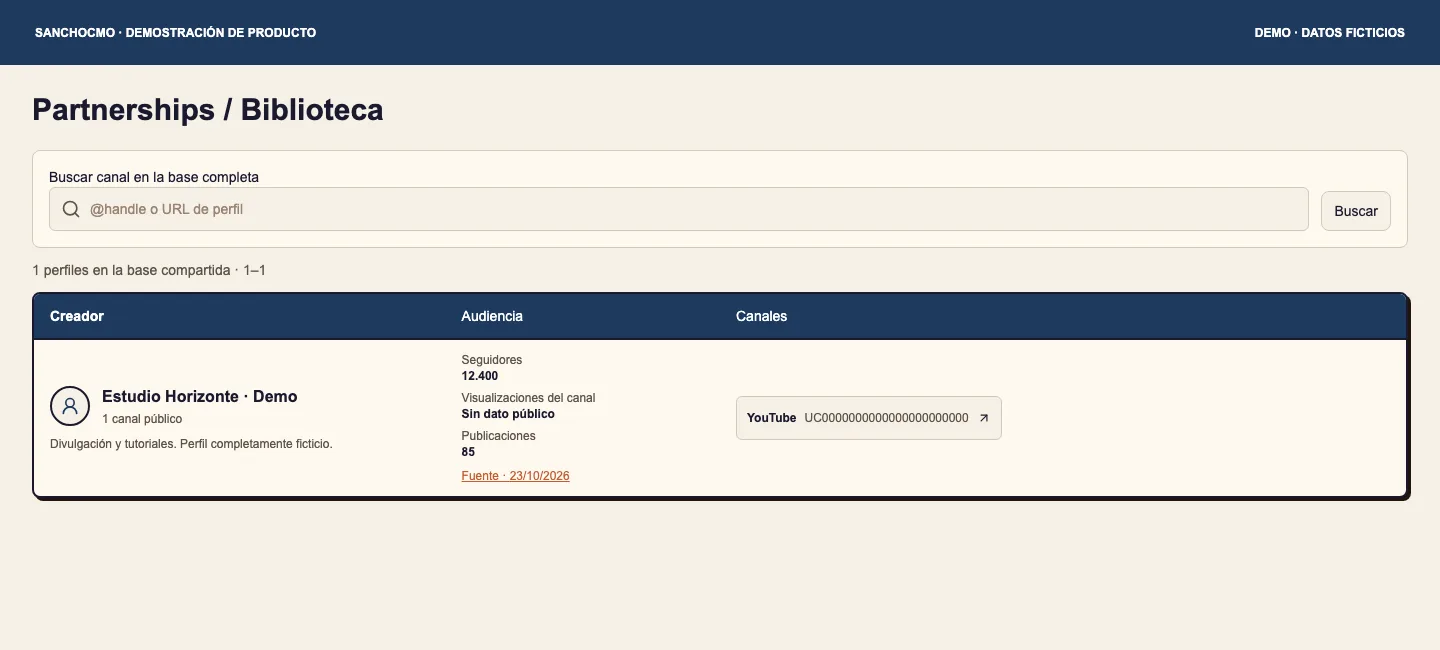
Different sources may refer to the same channel by a handle or a technical identifier. Check the channel link: two names do not necessarily represent two separate audiences.
2. Open the shared profile
Select the creator name or its Ver perfil compartido (View shared profile) control. The panel brings together the description, available metrics and channels. Select Cerrar (Close) to return to the library.
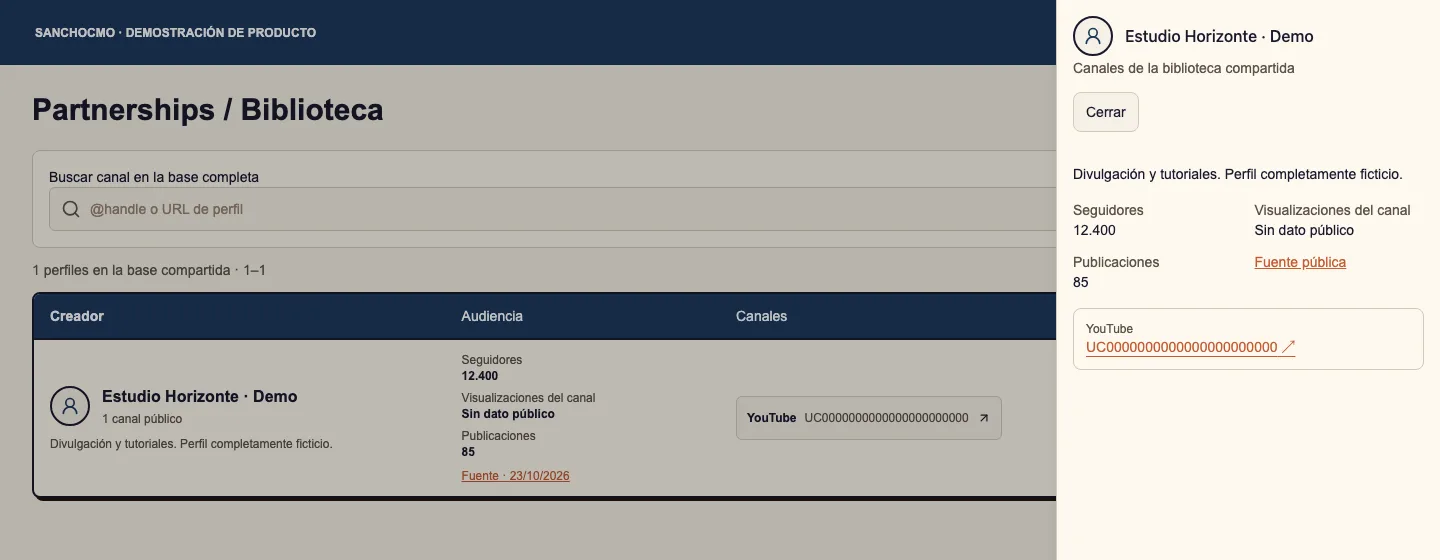
Confirm the platform and channel identifier in the panel. Opening a shared profile lets you read it; this action alone does not record a negotiation, approval or collaboration.
3. Read each metric in context
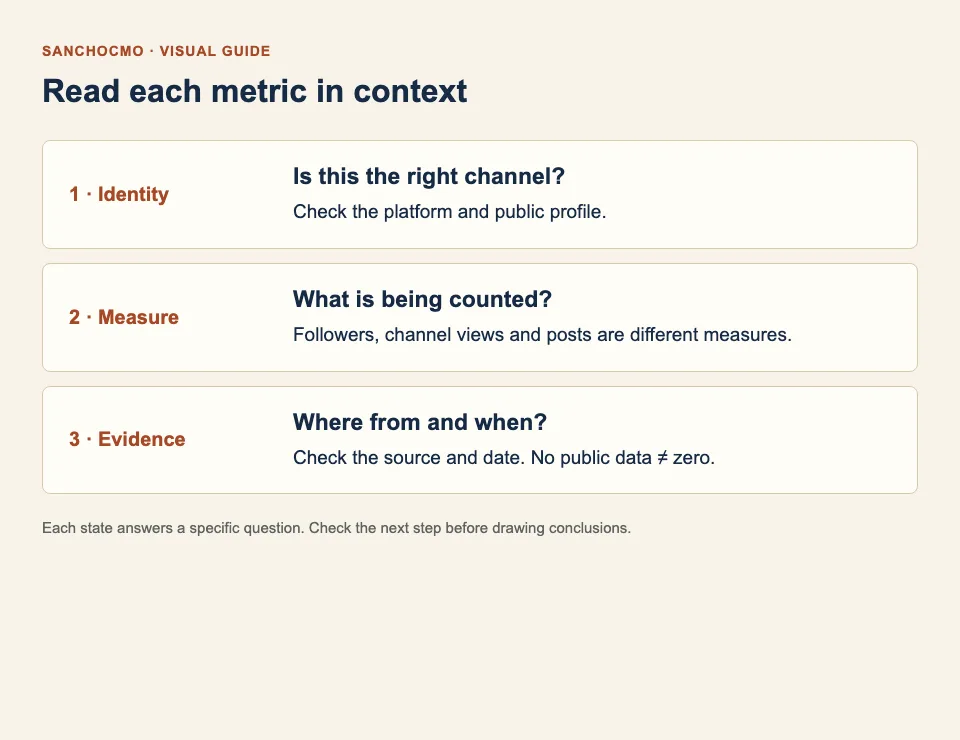
- Seguidores (Followers): the audience size reported by the source for this profile. It is not the reach of a post.
- Visualizaciones del canal (Channel views): views associated with the channel according to the source. Do not attribute them to a specific video.
- Publicaciones (Posts): the amount of content reported by the source. On its own, it does not show recent posting frequency or quality.
- Sin dato público (No public data): the library does not have this public value. Do not replace it with zero or derive it from another metric.
The example shows 12,400 followers and 85 posts, but no channel view count. The correct conclusion is that this measure is unavailable, rather than that the channel has no views.
4. Check the source and date
- In the library row, review Fuente (Source) and its accompanying date.
- Open Fuente pública (Public source) when you need to check the original profile. Confirm that it is the expected channel.
- Before comparing two profiles, check whether their sources and dates are comparable. Keep any difference visible in your assessment.
The date tells you when the displayed information was retrieved. It does not promise continuous updates or certify campaign results. If the link points to the wrong profile, pause the comparison and report the field that needs correction.
When something is missing or does not match
- Search does not return the channel: check the platform, handle and URL. A missing result does not prove that the channel does not exist.
- A metric is missing: keep the displayed status and request the value if your decision requires it. Do not present an estimate as observed data.
- You cannot see the library: ask the person managing your workspace to check your access to the area.
- You need to assess a collaboration: this profile provides public information. Review the relevant tracking and audit before making a decision.
Check your result
You should be able to identify the exact channel, explain what each figure measures and cite its source and date. Missing measures should still be marked unknown. You now have a verifiable basis for the next review, without implying approval of a collaboration.