Documentation / Metrics and results
Distinguish zero from an unknown value
Read a figure without turning missing information into a result. Check its measure, source and date before comparing.
When to use this guide
Use this guide when a value is missing from a library, report or data screen. The example uses channel views on a public creator profile. The distinction also helps with other metrics, although each screen may express missing information differently.
Screenshots use actual components with fictional profile data. Only the demo value changes between the two cases. They do not show results or incidents from a real account. The interface is in Spanish; visible controls are quoted below.
1. Identify the measure
- Open the screen you want to review and locate the measure name.
- Confirm the profile, platform or source it belongs to.
- Check the date and available period where shown. A profile retrieval date does not by itself define a campaign period.
In the creator library, Visualizaciones del canal (Channel views) is different from followers or views of a particular post. Comparing different measures can mislead even when both have numbers.
2. Recognize an unknown value
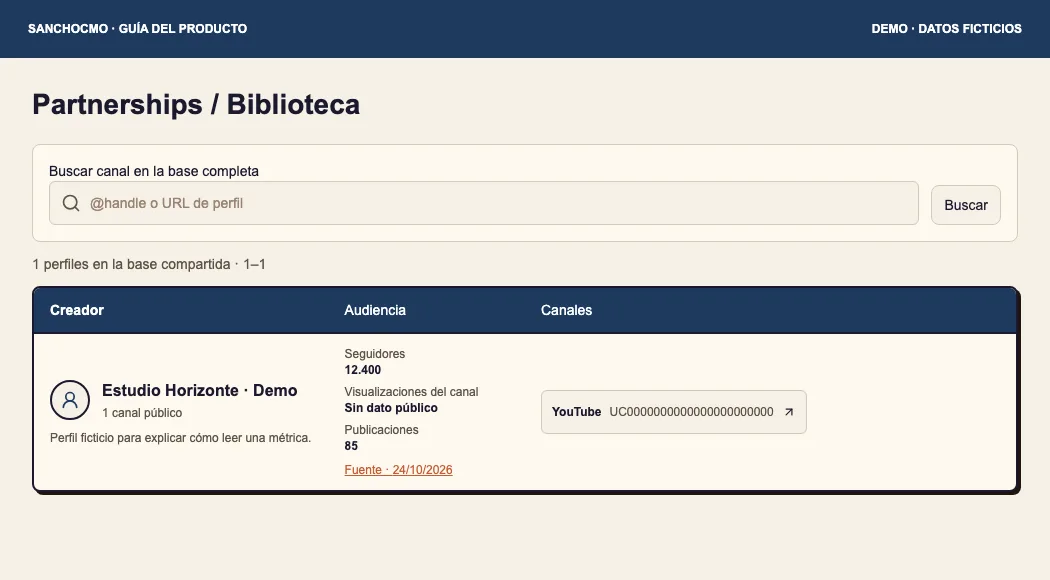
Sin dato público (No public data) means this value is unavailable in the public information displayed. Keep that absence visible in your review: “Channel views are unavailable for this lookup.”
Do not conclude that the channel has no views. Do not calculate a rate or average that requires the missing value. If your decision depends on it, identify the missing source and request a check.
3. Recognize a recorded zero
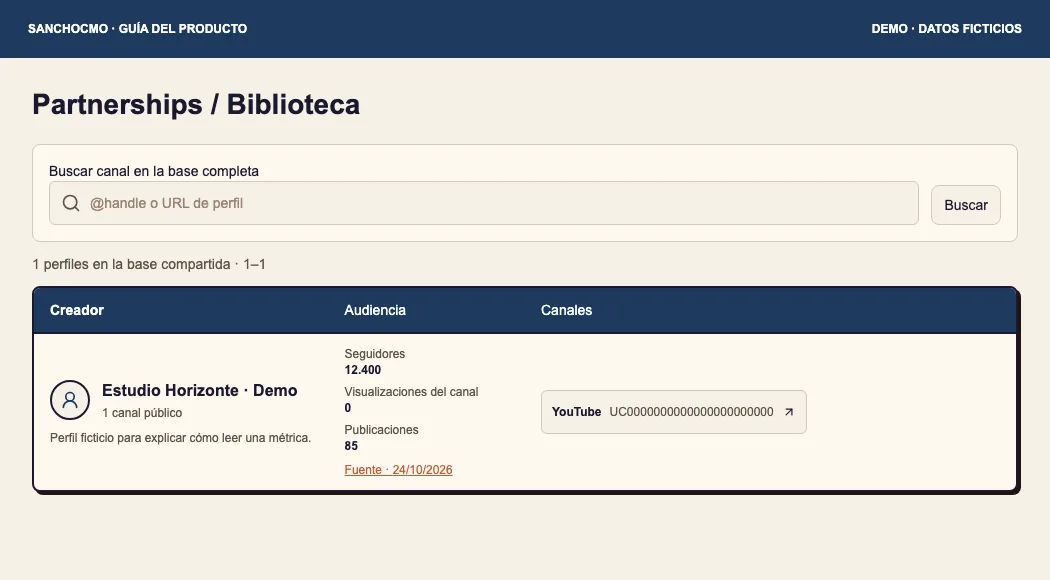
0 differs from a missing value: the source or record supplies a numerical zero. Still, check scope and date before drawing a conclusion about performance.
Zero for a specific measure and period does not establish that there has never been activity. An unexpected zero may also need checking against the source; having a number does not replace that review.
4. Keep the distinction when comparing
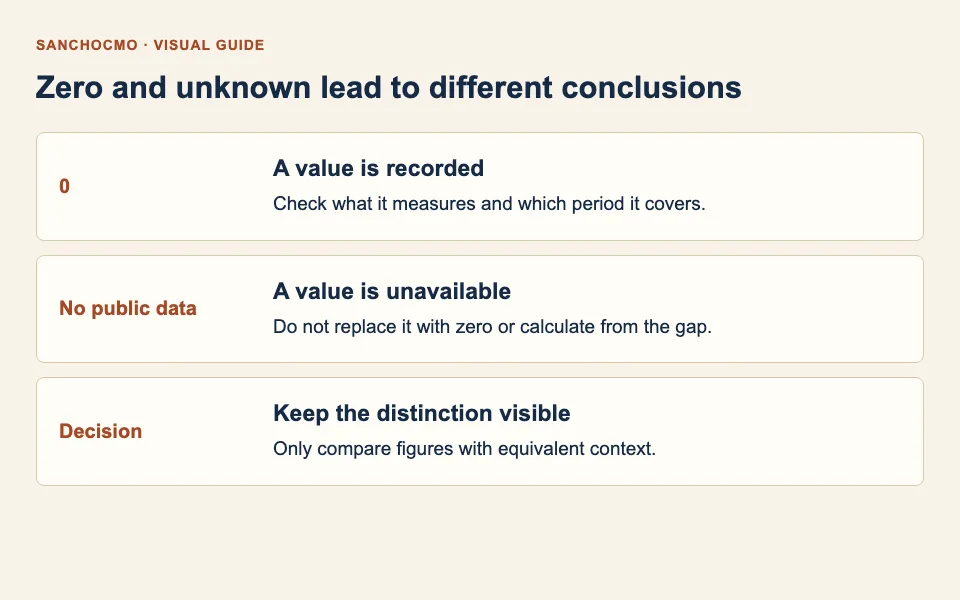
- Two comparable values: compare them when they represent the same measure and compatible context.
- A number and an unknown value: state that one case lacks information. Do not rank them as though the unknown value were zero.
- A sum or average: identify which records have data and which are excluded. Do not fill gaps without an explicit rule.
- A calculation dividing by zero: do not present it as a valid rate. Check whether the calculation makes sense with those values.
When something does not match
- Check that platform, unit, profile and period have not been confused.
- Open the source where available and compare its value and date.
- For integration data, check the published coverage period too.
- When asking for help, identify the measure, screen, date and visible state without replacing unknown information with an estimate.
Continue with reading a public profile or distinguishing connection from data.
Check your conclusion
Your reader should be able to distinguish what was measured, which value is available and what information is missing. If you cannot support one of those points, keep that uncertainty visible.